
This page is not a current Christchurch City Council document. Please read our disclaimer.

Net migration rather than natural increase (the excess of births over deaths) has been the major cause of the City’s recent population expansion. In a reversal of previous trends, natural increase accounted for only one quarter of total population change in 1994/95 compared to three quarters in 1991/92.
Despite contributing proportionately less to total growth, the level of natural increase has only fallen slightly during the first half of this decade. It is expected that the gradual reduction in the level of natural increase will continue until at least 2016 (see Appendix 1 for detailed projections).
Total Fertility Rates (TFR)[8] in Christchurch underwent a minor resurgence in the late 1980s and early 1990s after many years of gradual decline. The fertility rate for Christchurch City in 1991 was 1.80 births per woman compared to 1.66 in 1982-86 and 1.63 in 1977-81. This slight "recuperation" was largely due to women of the baby boom generation, who had delayed starting families. This period of increase now appears to be at an end with the long term trend of declining fertility rates re-establishing itself.
Overall, lower fertility will lead to progressively fewer children in the City’s population next century. Between 1996 and 2006, Christchurch’s TFR[9] is expected to decline from 1.70 to 1.63 births per woman, declining steadily thereafter to approximately 1.61 births per woman by the year 2016. These levels are well below the accepted rate of 2.1 births per woman required for population replacement. This trend highlights the importance of migration for Christchurch if the City is to continue to grow.
The TFR for Christchurch women continues to be lower than that for the country at large. In 1991, the national TFR was 2.16 births per woman (Figure 1.6). This was the second highest rate recorded since the mid 1970s but has subsequently declined. It is interesting to note that almost all developed countries, including Australia, England and the United States, have sub-replacement fertility rates.
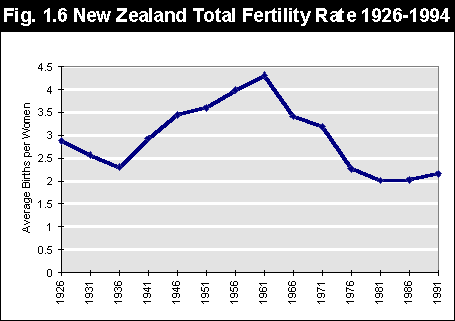
Source: Statistics New Zealand, Official Year book 1995
A number of factors have directly or indirectly contributed to the current low level of fertility. These include changing methods of family planning, increased participation of women in the labour force and rising divorce rates. Patterns of marriage and family formation have also changed radically. There has been a shift away from early marriage and childbearing to a wider range of partnership arrangements and generally older childbearing.