
This page is not a current Christchurch City Council document. Please read our disclaimer.

Unemployment
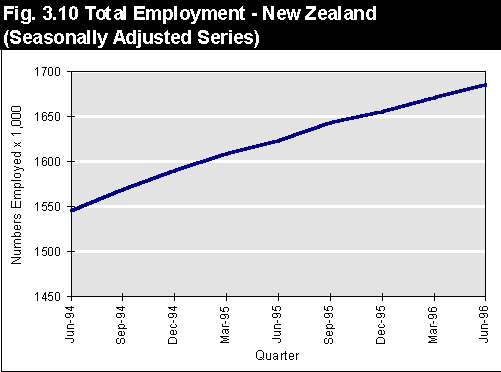
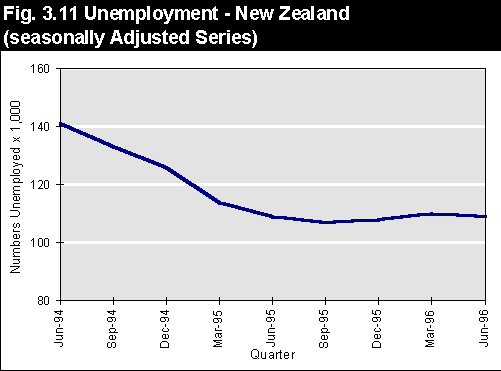
After a sustained period of decline national unemployment levels have stabilised over the last year. In the June 1996 quarter the official unemployment rate fell to 6.1 percent compared to 6.3 percent 12 months earlier. The current rate of unemployment is down significantly from the peak of approximately 11 percent recorded in March 1992. At a national level the continuing growth in employment and associated decline in unemployment are well illustrated in Figures 3.10 and 3.11. In the past 12 months 63,000 new jobs have been created while the number of people recorded as unemployed has remained largely unchanged.
Source: Statistics New Zealand
Source Statistics New Zealand
The high level of error associated with comparable estimates for Christchurch means this information cannot currently be provided for the City. However, data on registered unemployment from the New Zealand Employment Service does provide valuable insights into local trends.
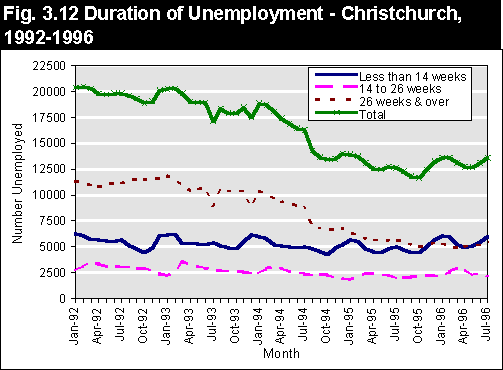
In keeping with the national trend, the level of registered unemployment in Christchurch has stabilised over the last year. In total, the number of registered unemployed increased slightly from 12,734 in June 1995 to 13,110 in June 1996, up 3 percent. It is of concern that this increase has continued in July and August with the total number of people now registered as unemployed growing to 13,583. It is possible however that this increase reflects normal seasonal variation rather than the beginning of an upward trend.
Nearly all of the recent increase has occurred in the ranks of the short term unemployed who have been registered for under 14 weeks. The number of long term unemployed has remained relatively stable actually declining slightly from 5,563 in June 1995 to 5,139 in June 1996. The medium term unemployed (registered for 14 to 26 weeks) have also remained relatively constant over the period (Figure 3.12).
Source: New Zealand Employment Service
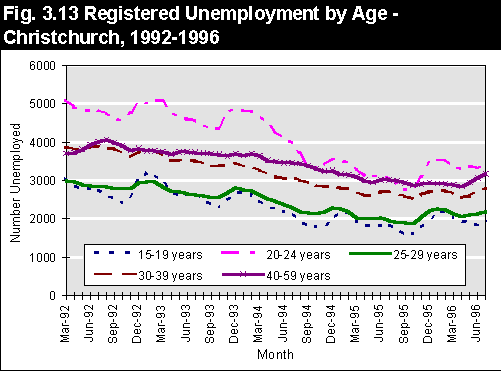
The downward trend in unemployment has been experienced across all age groups in recent years. The slight upturn noted in recent months appears to have had most effect on those aged 25 years and over with some reduction still evident for those aged 15-19 years. (Figure 3.13).
Particular groups are still heavily over represented on the unemployment register. For example, young people generally are over represented in the unemployment figures. People aged between 15-24 years represent about one quarter of the City’s working age population[5] but 39 percent of the registered unemployed. Maori aged 15-64 years represent about 5 percent of the City’s working age population but 13 percent of those currently registered as unemployed. A similar picture is evident for Pacific Islanders who represent approximately 1.5 percent of the working age population but 2.7 percent of the registered unemployed.
Source: New Zealand Employment Service