
This page is not a current Christchurch City Council document. Please read our disclaimer.

Employment
The strength of Christchurch’s recent period of sustained economic growth has been reflected in a substantial increase in both business numbers and employment.
Total employment has continued to increase strongly during 1995/96 growing by nearly 5 percent[3]. The level of total employment has now increased by a fifth since the recessionary low recorded in February 1992. (Table 3.2). Both full and part time employment have continued to grow in the last 12 months despite the slower rate of increase in overall economic activity. However, this growth has not been evenly distributed across all sectors of the economy with employment in most manufacturing industries either stagnating or declining. The majority of the recent growth has occurred in the service sector with the Construction; Transport and Storage; Financial, Insurance, Real Estate and Business Services; and Community Social and Personal Services industries growing strongly. Central government employment also increased during the year (up 7.5 percent) while local government employment fell slightly.
| Table 3.2 Business and Employment Trends 1991-1996 | ||||
|
|
|
|
|
|
|
|
|
|
|
|
|
|
|
|
|
|
|
|
|
|
|
|
|
|
|
|
|
|
|
|
|
|
|
The total number of businesses in the City increased by 14 percent between February 1995 and 1996. This increase has also not been evenly distributed across the economy but has largely been restricted to the Construction; and Financial, Insurance, Real Estate and Business Service sectors.
In line with national trends this growth has been accompanied by a shift in the type of employment offered within the local economy. While full time employment has increased strongly, up 17 percent since 1992, part time employment has increased at more than twice this rate up 37 percent over the same period. There has also been a marked increase in the level of self employment within the economy.
Information on the number of jobs advertised in Christchurch collected by the ANZ Bank provides a useful leading indicator of employment and business activity (Figure 3.9).
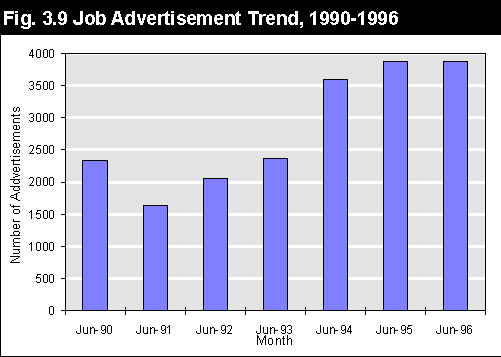
Source: ANZ Banking Group (New Zealand) Ltd
The trend in job advertisements illustrates the pattern of recession and recovery which has occurred in the first half of this decade. Recent monthly data reveals that the number of jobs being advertised has declined over the last 6 months. Despite this gradual contraction, the level of job advertisement remains high. For example, 2,342 vacancies were advertised locally in June 1990 compared to 3,870 vacancies in June 1996. ANZ Bank commentators believe:
"...the recent fall in job ads is consistent with the weakening in economic activity which has occurred over the course of the past 12 months............. Our forecasts indicate that GDP growth will reach a trough in the latter half of 1996."[4]
It seems likely the rate of employment growth will slow in 1996/97 in line with the more moderate level of economic activity expected before increasing again for the remainder of the decade.