
This page is not a current Christchurch City Council document. Please read our disclaimer.

Inflation, Interest Rates and the Dollar
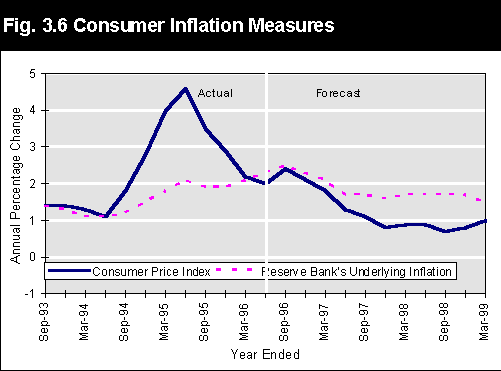
Figure 3.6 summarises recent trends in the two most widely used measures of inflation -the Consumer Price Index and the Reserve Bank’s index of underlying inflation.
Source: Statistics New Zealand; Reserve Bank of New Zealand
The Consumer Price Index (CPI) measures changes in price levels as they affect households’ expenditure. The CPI has trended downward over the last 12 months after peaking at an annual rate of 4.6 percent in June 1995. The index is expected to temporarily increase again to 2.4 percent in September 1996 before declining to very low levels for the remainder of this decade. The expected tax cuts in mid-1997 are not expected to be a cause of major concern.
The Reserve Bank’s measure of underlying inflation is used for monetary policy management. The index adjusts the CPI for:
• significant changes in the terms of trade;
• an increase or decrease in GST, or other significant indirect taxes;
• a crisis such as natural disaster;
• a significant price level impact resulting from changes in government charges; and
• interest rate effects.
The Reserve Bank is currently required to maintain underlying inflation within the 0-2 percent range. However, it seems likely this target will be reviewed over coming months as central government coalition talks proceed. Under current policy settings underlying inflation is expected to peak in September 1996 at an annual rate of 2.5 percent. The rate has now breached the 0-2 percent target on three occasions over the last year and is expected to do so again in the next three quarters. However, the Reserve Bank now believes that inflationary pressure is beginning to ease. The rate is expected to decline to around 1.7 percent over the next 2 years before easing further at the end of the decade (Figure 3.7).
Exchange rate and interest rate levels are both key elements in the Reserve Bank’s monitoring of monetary policy and major influences on the profitability of many local businesses, particularly those involved in exporting. Table 3.1 outlines recent movements in key exchange rates for local exporters and the trade weighted exchange rate index (TWI).
The TWI continues to follow an upward trend. The index appreciated by 6.8 percent between July 1995 and 1996. This increase is attributed to the high real interest rate differential which exists between New Zealand and other OECD countries. This gap is currently estimated at approx 6 percent and has resulted in strong demand for New Zealand bonds. The Australian/New Zealand cross rate has eased during the last 12 months after peaking at 0.95 in 1995. This adjustment has been particular welcomed by local
manufacturers. The NZIER is forecasting the rate of appreciation in the TWI will ease over the next 12 months from over 6 percent to approximately 2-3 percent per annum between now and the year 2001.
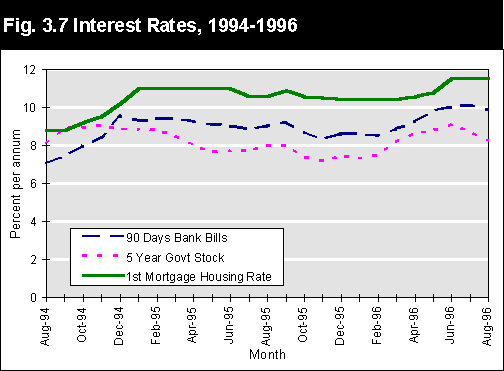
The interest rate profile from August 1994 to August 1996 is outlined in Figure 3.7.
Source:Reserve Bank of New Zealand
The high real interest rate differential between New Zealand and the rest of the world remains as a consequence of the tight monetary conditions set by the Reserve Bank and the risk premium investors are demanding in New Zealand at this time. Commentators are expecting rates to begin to fall gradually. However, there are a number of risks facing any possible interest rate reductions. These include:
Robust growth in the US economy which might result in higher interest rates internationally.
The growth of the current account deficit which may cause investors to withdraw funds from the New Zealand market. The likely result would be lower exchange rates but higher interest rates.
Any change in monetary or labour relations policy which might lead to higher rates due to increased inflationary fears and uncertainty over the impact of such changes on economic performance.
| Table 3.1 Exchange Rates and Trade Weighted Exchange Rate Index | |||||
| Monthly Mid Rates |
Trade Weighted Exchange Rate Index |
Australia (A$/NZ$1) |
USA (US$/NZ$1) |
West Germany (DM/NZ$1) |
Japan (Yen/NZ$1) |
| Jul-95 | 61.7 |
0.9153 |
0.6750 |
0.9312 |
59.48 |
| Aug-95 | 61.3 |
0.8625 |
0.6505 |
0.9611 |
64.45 |
| Sep-95 | 61.5 |
0.872 |
0.6555 |
0.9300 |
64.99 |
| Oct-95 | 62.2 |
0.8688 |
0.6607 |
0.9307 |
67.38 |
| Nov-95 | 62.2 |
0.8753 |
0.6550 |
0.9420 |
66.53 |
| Dec-95 | 62.3 |
0.8777 |
0.6533 |
0.9396 |
67.13 |
| Jan-96 | 64.7 |
0.9006 |
0.6683 |
0.9950 |
71.66 |
| Feb-96 | 63.8 |
0.8787 |
0.6708 |
0.9835 |
70.13 |
| Mar-96 | 64.3 |
0.8679 |
0.6783 |
0.9999 |
72.02 |
| Apr-96 | 65.0 |
0.8721 |
0.6872 |
1.0501 |
72.08 |
| May-96 | 64.6 |
0.8561 |
0.6825 |
1.0480 |
73.53 |
| Jun-96 | 65.1 |
0.8678 |
0.6846 |
1.0389 |
74.68 |
| Jul-96 | 65.9 |
0.8882 |
0.6931 |
1.0241 |
74.83 |
Source: Reserve Bank of New Zealand