
This page is not a current Christchurch City Council document. Please read our disclaimer.

Economic Activity
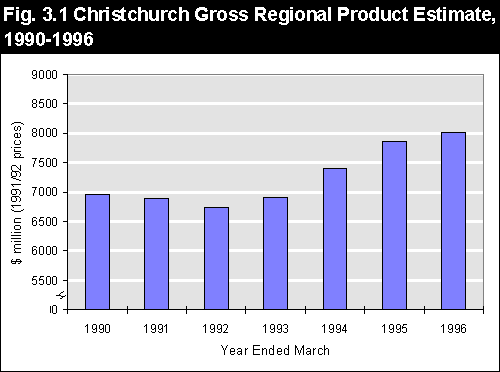
Regional estimates of Gross Domestic Product (GDP) provide useful indicators of trends in the level of local business activity. GDP is equal to the total market value of goods and services produced after deducting the cost of goods and services used in the process of production but before deducting allowances for the consumption of fixed capital. This indicator is generally accepted as the principal measure of national market activity. The Christchurch estimate is calculated by weighting official industry GDP statistics using regional employment weights [1](Figure 3.1).
Source: Statistics New Zealand; GRP Estimate - Christchurch City Council
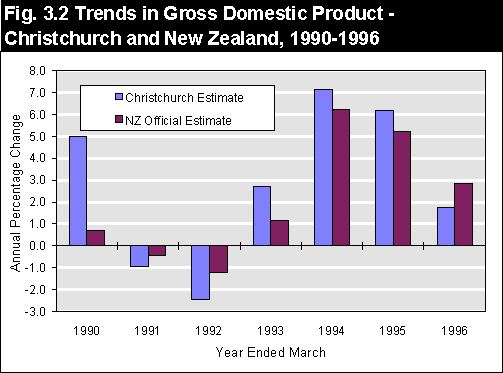
In real terms, the Christchurch economy is estimated to have grown by 18.9 percent in the last four years. This compares to growth of 16.3 percent nationally. As Figure 3.2 shows, the local economy is estimated to have grown at a slightly slower rate than the national economy in the last financial year. In the year to March 1996, Christchurch’s Gross Regional Product (GRP) is estimated to have increased by 1.8 percent compared to 2.8 percent for New Zealand. This result contrasts with the very high levels of growth seen in the previous three years when the Christchurch economy out performed that of the country as a whole. In current dollar terms, the value added in local production is now estimated at nearly 9 billion dollars per annum.
The extent of this recent decline reinforces the view that Christchurch, in combination with the wider Canterbury region, has an outward orientated economy which recovers or declines ahead of many other areas of New Zealand. There are several reasons suggested for this pattern however the key factor is seen as the responsive, export oriented nature of the local economy. This results from the outward focus of a significant group of local manufacturers, the sizeable tourist industry and the influence of the large rural economy of Canterbury.
Source: Statistics New Zealand; GRP Estimate - Christchurch City Council
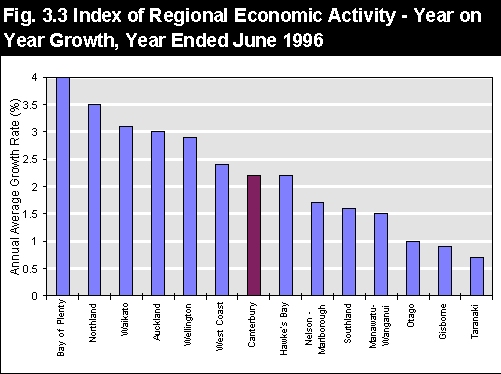
The National Bank of New Zealand has produced an alternative measure of regional activity. The composite index of economic activity summarises trends in a selection of regional economic data and can be used to measure comparative economic performance. For the year to June 1996, the index for Canterbury increased by 2.2 percent. This ranked Canterbury seventh out of the fourteen districts identified (Figure 3.3).
Source: National Bank of New Zealand Ltd
While the Canterbury economy continues to grow at a respectable rate, growth has eased consistently from the peak of 6.5 percent recorded two years ago. It is notable that while Canterbury is still to rebound from this downward trend centres such as Bay of Plenty, Northland, Waikato and Wellington have now had several quarters of accelerating growth. This is reflected in the higher annual growth rates recorded in these districts under the National Bank’s system. At this time there is no clear pattern to the forces generating the additional growth in these centres. Although, one common factor has been an upturn in either residential/commercial construction or real estate activity accompanied in several cases by increased vehicle sales. This suggests the growth is driven by increased consumer spending.