
This page is not a current Christchurch City Council document. Please read our disclaimer.

City-Wide Development
Seventy one percent of residents thought developments throughout the City had made Christchurch a better place to live. This approval rating has increased substantially from the 46 percent identified in 1991 ( Figure 2.11).
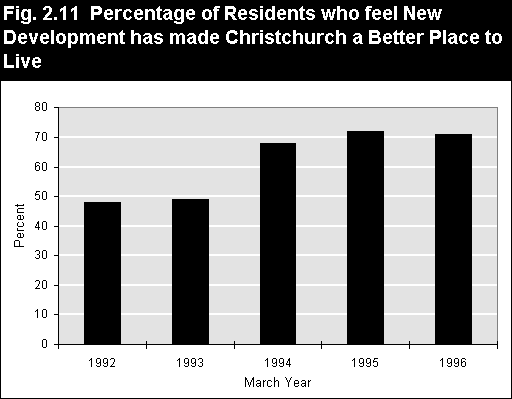
Source: Christchurch City Council, Annual Survey of Residents
Only 10 percent of residents thought new city wide developments had made the city a worse place to live. The main criticisms concerned the process of infill housing and cross leasing. A number of residents opposed policies resulting in increased population density. Concerns were also expressed about the unappealing nature of new high rise buildings, the loss of character and historic buildings, the Casino complex, the noise and impact on traffic of the Trams and the impact of tourism on the Central City.
According to the 1996 Annual Survey of Residents, the Central City remains a popular place for residents to visit. Ninety seven percent of those working in the Central City had also visited for non-work purposes during the last year. While 94 percent of people who do not work in the City had visited. The frequency of non-work visits was also high with 46 percent visiting once a week or more and a further 34 percent visiting once a month or more. The most popular activity during non work trips were shopping (38 percent), socialising (20 percent) and business. Over three quarters (76 percent) of residents expressed satisfaction with the range of things to do in the Central City. Only 7 percent expressed any level of dissatisfaction with the range of opportunities available.
The Port Hills are a valuable natural landscape featuring many indigenous plant species. They form a stunning backdrop for the City and provide many recreational opportunities for residents and visitors. Currently there is agricultural and forestry production on the Port Hills. Vast areas have been set aside for reserves and parks while there is residential housing on many of the lower slops.
| Table 2.12 Residents Opinions on Further Development on the Port Hills | |||||||||||
Housing (%) |
Forestry (%) |
Farming (%) |
Tourism & Recreation (%) |
||||||||
1992 |
1996 |
1992 |
1996 |
1992 |
1996 |
1992 |
1996 |
||||
| Strongly Agree | 1 |
2 |
12 |
8 |
2 |
2 |
8 |
6 |
|||
| Agree | 35 |
20 |
65 |
57 |
36 |
36 |
53 |
50 |
|||
| No Feeling | 16 |
16 |
7 |
10 |
18 |
21 |
10 |
13 |
|||
| Disagree | 37 |
35 |
12 |
16 |
37 |
31 |
24 |
22 |
|||
| Strongly Disagree | 9 |
25 |
3 |
7 |
2 |
6 |
4 |
7 |
|||
| Don't know | 2 |
3 |
1 |
1 |
3 |
3 |
1 |
2 |
|||
| Total | 100 |
100 |
100 |
100 |
100 |
100 |
100 |
100 |
|||
The 1996 Annual Survey of Residents showed that opposition has increased to further development on the Port Hills with 36 percent of respondents saying the Council should do more to stop further development on the Port Hills compared to 22 percent in 1992. The survey also sought information on the type of developments which should be allowed. Housing development was opposed by 60 percent an increase of 14 percent since 1992. However, 65 percent favoured further forestry development and 56 percent additional tourism and recreation. Views on additional farming activity were split with 38 percent supporting additional development and 37 percent opposing.
The latest Annual Survey of Residents asked whether the Council should try to attract aviation industry to Wigram. Respondents were told the Council might be required to make an on-going financial contribution to the operation, it would create jobs and could attract other new industry. They were also told the site could be used for housing rather than aviation.
Sixty four percent of residents supported Council involvement with only 11 percent opposing this initiative. The majority opposing Council involvement supported using the site for housing. The level of noise associated with aviation was seen as a major drawback, with a number of people questioning the need for two airports.