
This page is not a current Christchurch City Council document. Please read our disclaimer.

Land-Based Litter Counts
Twice each year a physical count of litter in 111 sites throughout the City is undertaken by the Keep Christchurch Beautiful Campaign. Since counting began there has been an overall reduction of 65 percent in the total amount of litter recorded from 7,259 items in December 1990 to 2,611 in December 1995. Although paper and card continue to be the main type of litter collected, this type of litter has decreased significantly (Figure 2.9). There has also been a notable decline in:
• aluminium cans, attributed partially to the introduction of "Cash for Cans" schemes.
• tear tabs - attributed to the new aluminium drink can design. Once the newly designed cans are opened the tear tabs no longer become detached.
• glass - attributed to less glass packaging and the introduction of recycling drop-off centres and increased public education on waste minimisation.
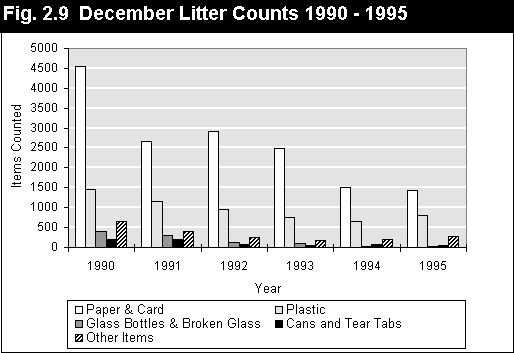
Source: Keep Christchurch Beautiful.
Sewage treatment is an extremely large, complex and expensive operation that is vital for the health and well being of the community. Sewage, which is almost all water is carried through a network of underground pipes to the sewage treatment plant. The aim of sewage treatment is to remove all pollutants and produce an effluent that is as near as possible to fresh water, which can then safely be reused or returned to the environment.
Currently the City’s sewage treatment system processes waste for an estimated 314,000 people. On average, 155,000m3 of effluent per day flows through the treatment works (July - June 1996). During the year to June 1996, 9.2 percent of effluent was from Industrial Sources. While the remaining effluent was from a variety of sources including domestic waste and stormwater. Average effluent flow has increased at a rate consistent with population growth, although the annual average flow fluctuates from wet year to dry year due to groundwater and stormwater entry into the sewage system.
Modern sewage treatment involves full primary and secondary treatment processes plus oxidation ponds and discharge into the Avon Heathcote Estuary. Gravity conveys sewage from approximately 100,000 lateral connections and through 1,300 kilometres of mains towards the treatment plant at Bromley. Over 70 pumping stations pump the sewage from low areas, particularly near the Avon and Heathcote Rivers.
Primary Treatment removes up to 30 per cent of the organic pollution load and up to 60 per cent of the suspended solids. This is achieved through a series of specialised screens, pre aeration and grit removal tanks and primary sedimentation tanks.
From the primary sedimentation tanks the effluent is pumped to the top of two trickling filter towers. Micro organisms growing within these towers feed on the dissolved organic pollution as the liquid trickles down over the media. The liquid then flows into secondary sedimentation tanks and then to the oxidation ponds. Up to 80 per cent of the remaining organic pollution load and up to 30 per cent of the remaining suspended solids are removed during the secondary treatment.
The 230 hectares of oxidation ponds serve a dual purpose of removing a portion of the remaining pollution load and greatly reducing disease causing micro-organisms. The oxidation ponds also provide an important habitat for a variety of bird species as the Te Huinga Manu Wildlife Refuge.
Discharge of effluent into the Avon Heathcote Estuary occurs twice a day a few hours following high tide. This ensures that most of the discharge moves straight out to sea with the falling tide. It contains very little dissolved pollution load and virtually all of its suspended material is in the form of green algae and zooplankton, which are used extensively as a source of food by estuarine fish. Micro-organisms that remain in the effluent are a mixture of those that survive the pond system and are those contributed by the resident bird life. These do not normally have an adverse effect on the estuary except in a small area adjacent to the outfalls.
Sludge from the primary and secondary processes is pumped to four digesters. Each digester holds 5000 m3 of sludge and is heated to 38oC. Bacteria break down the sludge releasing carbon dioxide and methane. This process changes the sludge into an odourless free draining material that is then stored in open lagoons before being used as a soil conditioner and fertiliser.
The methane produced is used as a fuel in engines for driving pumps, heating the digesters and buildings, and to provide electric power for the plant and the national grid. In this way the Christchurch Treatment Works is 95 per cent self sufficient in energy.