
This page is not a current Christchurch City Council document. Please read our disclaimer.

Solid Waste
The production of solid waste including household rubbish, commercial and industrial waste and garden waste, is an inevitable consequence of most human activity. However, the amount produced in the City can be reduced in order to use resources more efficiently and reduce impacts on the environment.
To effectively reduce waste, a good understanding of waste volumes, sources and composition in Christchurch is necessary. Each of the City’s transfer stations and the landfill site are equipped with weighbridges to enable the accurate monitoring of waste quantities. While the composition of various waste streams is determined by sampling the refuse at source or at the transfer station and landfill site.
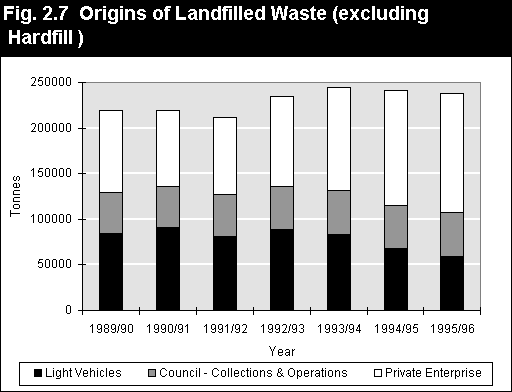
During the year to June 1996, the City produced 254,293.2 tonnes of solid waste excluding hardfill. Of this figure just under 238,000 tonnes was landfilled at the Burwood landfill site, while 16,498.3 tonnes was composted at the City’s composting Plant at Bromley.
The amount of solid waste disposed of at the landfill site steadily increased until 1994 reflecting the Christchurch’s growing population, changing lifestyles and increasing business activity within the City. However, over the last two years, the amount of landfilled solid waste declined. This is attributable to the reduction in landfilled ‘clean green waste’ (including grass clippings, hedge prunings, tree prunings, leaves and plants) which is now taken to the Councils Composting Plant for recycling into ‘Envy’ compost products and made available for sale.
Composting not only reduces the amount of landfilled waste but also lessens the potential green house effects of gas emission form waste. This is because the natural aerobic composting process produces carbon dioxide, rather than methane which would result if the material was landfilled.
While the overall amount of landfilled waste has decreased, waste from commercial sources has increased. This is a mix of private domestic collection, and business/industry waste (Figure 2.7). With the Compost Plant working successfully, diverting part of the second largest waste type, the Council plans to target commercial waste sources to further reduce the waste stream.
| Table 2.10 Total Waste Including Green Waste to the Compost Plant (tonnes) | |||||||
1989/90 |
1990/91 |
1991/92 |
1992/93 |
1993/94 |
1994/95 |
1995/96 |
|
| Green Waste (Composted) | 0 |
0 |
0 |
0 |
0 |
7803.6 |
16498.3 |
| Light Vehicles | 84073 |
90779 |
81290.6 |
89217.1 |
82791.5 |
67658.7 |
59647.5 |
| Council Collection & Operations | 45709 |
45479 |
45668.4 |
46566.9 |
48503.8 |
47585.2 |
48056.1 |
| Private Enterprise | 88996 |
82692 |
84673 |
99325 |
113085.9 |
126289.2 |
130091.3 |
| Total | 218,778 |
218,950 |
211,632 |
235,109 |
244,381.2 |
249,336.7 |
254,293.2 |
Source: Christchurch City Council, Annual Survey of Residents
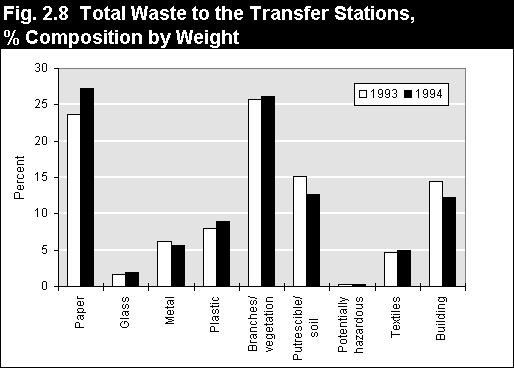
Results from the 1993 and 1994 waste audits show that paper and branches/vegetation comprise the greatest proportion of refuse by weight, taken to transfer stations (Figure 2.8). In 1994, paper and branches/vegetation accounted for 27.2 and 26.1 percent of waste respectively. Both types of refuse have increased slightly in recent years.
Source: Christchurch City Council
Source: Christchurch City Council
Reuse and Recycling of the City’s Waste
Recycling and reuse of materials such as glass, paper, wood, oil, plastic and metals is a way of reducing the need for landfill disposal of solid waste. Reuse is the repeated or continued use of a product in its original
form. While recycling involves the breakdown of products into their constituent materials either by melting (as in the case of metal, glass or plastic) or maceration (as in the case of paper), followed by the reformation of the material into new products.[5]
Currently in the City, there are a number of ways residents can recycle material. There is a kerbside collection of newspapers for recycling (full kerbside recycling will be implemented next year). A series of community drop-off points for recyclables are available throughout the city and the Resource Recovery Centres at the Transfer Stations collect recyclable materials.
The Council’s 1996 Annual Survey of Residents shows that many respondents had recycled various materials and items in the 12 months prior to the survey. Newspapers were recycled by 81 percent, glass by 60 percent and aluminium cans by 40 percent of respondents.
Overall, the proportion of residents recycling all other materials and items listed below have remained relatively constant (Table 2.11).
According to the Annual Survey of Residents, approval of what the Council is doing to encourage people to re-use and recycle thing has increased from 21 percent in 1994 to 34 percent in 1996. In contrast the proportion of respondents who believed that the Christchurch City Council should do more to encourage re-use or recycling has declined over the two years from 75 percent to 64 percent.
| Table 2.11 Percentage of Residents Re-using or Recycling Various Material and Items 1991 - 1996 | ||||||
1991 |
1992 |
1993 |
1994 |
1995 |
1996 |
|
| Glass | 59 |
70 |
67 |
63 |
58 |
60 |
| Newspapers | 72 |
82 |
83 |
83 |
83 |
81 |
| Aluminium cans | 43 |
53 |
50 |
45 |
38 |
40 |
| Plastic | 21 |
36 |
40 |
36 |
35 |
38 |
| Engine oil | 14 |
18 |
18 |
_ |
20 |
_ |
| Clothing or shoes | 84 |
85 |
84 |
_ |
79 |
_ |
| Scrap metal or old appliances | 19 |
18 |
18 |
_ |
26 |
_ |
Source: Christchurch City Council, Annual Survey of Residents