
This page is not a current Christchurch City Council document. Please read our disclaimer.

Air Pollution Complaints
The City Council and the Canterbury Regional Council are jointly responsible for investigating complaints about air quality in the City ie odours, fumes, dust and smoke. In the year to June 1996, 209 complaints relating to air quality were made to the City Council compared to 258 in 1994/95.
During 1996, 1,459 air quality complaints were received by the Canterbury Regional Council. The majority of these complaints were for the Christchurch City area.
The Survey of Annual Residents shows that most people in Christchurch do not find pollution from backyard fires and other sources a problem. However the proportion who do find it a problem has increased slightly. This may reflect the public’s growing awareness of the health related impacts of air pollution (Table 2.6).
| Table 2.6. Percentage of Residents who have had Problems with Types of Air Pollution | |||
1994 |
1995 |
1996 |
|
| Smoke from Backyard Fires | 15 |
14 |
16 |
| Other Types of Air Pollution | 19 |
19 |
22 |
The rapidly increasing population, higher density living in many residential areas, changing lifestyles and new technology all influence the level of noise within the environment. Controlling noise is an important aspect of environmental management in the urban area because of the major impact noise can have on public health and well-being. At high levels and over prolonged periods noise damages hearing. While low levels of environmental noise affect well-being by interfering with activities such as sleep and communication. The City Council is responsible for controlling noise in the City. As part of its function the Council receives and investigates noise pollution complaints.
Although the annual number of complaints received by the Christchurch City Council has grown over the last few years, the actual rate of growth has slowed down considerably. For example, complaints increased by 12.1 percent during 1995/96 compared with 21.8 percent in 1994/95 and 28.1 percent in 1993/94.
As in previous years, the majority (84 percent) of noise complaints in 1996 originated in residential areas (5,891) (Figure 2.5.).
Music and music related complaints continue to form the major source of annoyance in both residential and commercial premises. In 1996, this source accounted for just over 90 percent of residential noise complaints (5,326) and 51.8 percent of industrial/commercial noise complaints (557).
Burglar and other alarms were also a major source of complaints with 224 and 153 complaints in resident and commercial areas respectively.
While there has been an increase in the number of recorded noise complaints, according to the Annual Survey of Residents, the majority of residents do not find noise from neighbours, industry/commerce or traffic a problem. Table 2.7 shows that the proportion of residents who have experienced problems with various types of noise has remained relatively low over the past five years, although the problem of traffic noise appears to be increasing.
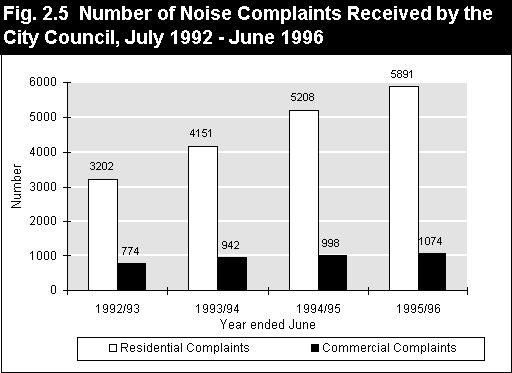
Source: Christchurch City Council
| Table 2.7. Percentage of Residents Who Have Had Problems with Types of Noise | ||||||
1991 |
1992 |
1993 |
1994 |
1995 |
1996 |
|
| Neighbourhood Noise | 19 |
21 |
22 |
18 |
22 |
20 |
| Industrial & Commercial Noise | 9 |
10 |
8 |
9 |
10 |
7 |
| Noise From Traffic | _ |
_ |
_ |
22 |
24 |
25 |
Source: Christchurch City Council, Annual Survey of Residents