
This page is not a current Christchurch City Council document. Please read our disclaimer.

Air Quality
Air pollution can have a major impact on the environment and its people. For example, short term exposure to pollutants can lead to health problems such as lung and eye irritations, while long term exposure has the potential to cause permanent damage to the respiratory and nervous systems. In addition, air pollution can damage buildings and plant life. It can also be dissolved by rain, then wash into drains, contaminating rivers and streams.
Christchurch City is particularly susceptible to air pollution. Cold air draining from the Southern Alps and the Port Hills collects in the Christchurch "basin". This forces warm air upward, creating a temperature inversion that traps air and pollutants underneath.This forces warm air upward, creating a temperature inversion trapping air and pollutants beneath.
Air pollution is generated by a combination of industrial, commercial and domestic activities and vehicle emissions. The most common air pollutants are sulphur dioxide (SO2), nitrogen dioxide (NO2), carbon monoxide (CO), ozone (O3), lead and suspended particulate matter (PM10) ie smoke.
The Canterbury Regional Council (CRC) undertakes extensive air quality monitoring within Christchurch. Sulphur dioxide, nitrogen oxide, nitrogen dioxide, carbon monoxide and smoke have been measured at a continuous monitoring site in St Albans since 1988. Wind speed, wind direction and air temperature at ground level and at three metres are continuously measured at this site. While some monitoring has also been carried out on visibility and humidity.
Short term monitoring has been undertaken by the CRC at various sites around Christchurch for smoke, carbon monoxide and sulphur dioxide. The Ministry of Health has also measured levels of lead at three sites around the City.
Results of the monitoring programme carried out over the 1988-1995 period 1988-1995 have been published in the CRC’s Annual Regional Environment Report 1994-1995, and are summarised below.
Monitoring of Sulphur Dioxide, Nitrogen Dioxide, Carbon Monoxide and Suspended Particulate (Smoke) - St Albans Monitoring Site
Air quality is highest around midday while peaks in contaminant concentrations generally occur in the evenings from 8pm to 12pm. Concentrations reduce to low levels during the early morning and peak again with morning traffic. The maximum 24-hour average concentration of sulphur dioxide and nitrogen dioxide at the St Albans monitoring site have been consistently lower than the relevant guidelines (Table 2.3 and Figure 2.2). Annual and hourly concentrations of sulphur dioxide and hourly concentrations of nitrogen dioxide have also been well within guidelines.
24-hour guideline concentrations for PM10 (smoke) have been exceeded in most years since 1988. The number of days since 1988 when the maximum level for smoke (ie 120 µg/m3 ) was exceeded are outlined in Figure 2.3. During the 1996 winter this guideline was exceeded on only 1 day. This is considerably less than the levels recorded in the early 1980’s when the guideline was exceeded on more than 20 days per annum, in several years.The current average of about 1 days per annum is considerably lower than the levels recorded in the early 1980’s when there were several years when guidelines were exceeded on more than 20 days per annum. Due to a review of the effects of air pollution on health, the Canterbury Regional Council recently adopted a monitoring and reporting guideline of 50 æ g/m3 (averaged over 24 hours). This level has been exceeded by between 19 to 37 days each year since 1988 at the St Albans monitoring site (Figure 2.3).
Concentrations of carbon monoxide have also exceeded the 8 hour guideline concentration during most years since 1988. The frequency of exceedence and maximum levels of carbon monoxide are summarised in Figure 2.4.
Source: Canterbury Regional Council, Regional Environment Report 1994/95
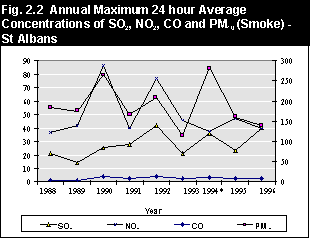
Source: Canterbury Regional Council.
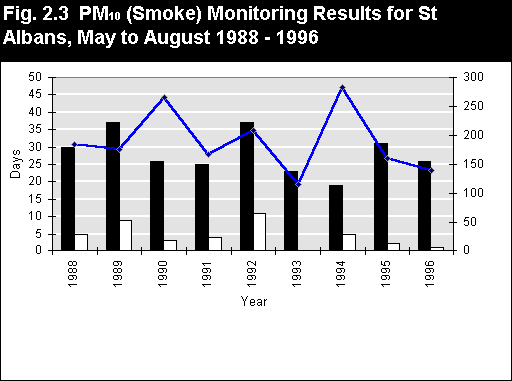
Source: Canterbury Regional Council
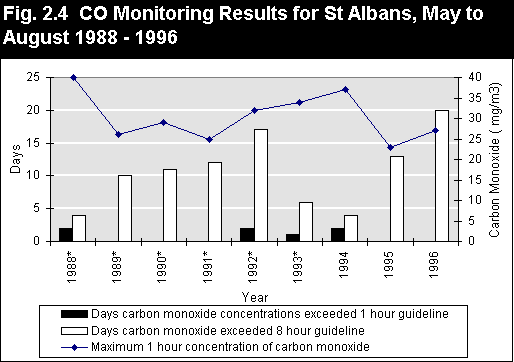
Source: Canterbury Regional Council
Most of the guideline exceedences for smoke and carbon monoxide concentrations occurred in June and July with only occasional breaches either side of the main winter months.
Overall, the monitoring results available from the St Albans site for the period 1988-1996 do not indicate any significant trends of increasing or decreasing concentrations of contaminants. Yearly variations are largely influenced by the frequency and extent of the winter temperature inversion, whichwhich occurss on days of low wind speed.
| Table 2.4. Summery of 1995 Air Quality Monitoring at St Albans, Opawa, Beckenham, and Hornby sites. | ||||||||
| Site | CO 8 hour |
CO 1 hour |
PM10 24 hour |
PM10* 24 hour |
SO2 10min |
SO2 1 hour |
SO2 24 hour |
|
| St Albans | Days exceeding guidelines | 6 |
0 |
2 |
30 |
0 |
0 |
0 |
| Max Conc. | 13 |
23 |
161 |
161 |
73 |
64 |
23 |
|
| Opawa | Days exceeding guidelines | - |
- |
2 |
27 |
0 |
0 |
0 |
| Max Conc. | - |
- |
137 |
137 |
369 |
214 |
57 |
|
| Beckenham | Days exceeding guidelines | 0 |
0 |
0 |
2 |
- |
- |
- |
| Max Conc. | 8 |
12 |
81 |
81 |
- |
- |
- |
|
| Hornby | Days exceeding guidelines | 0 |
0 |
0 |
3 |
0 |
0 |
0 |
| Max Conc. | 6 |
8 |
71 |
71 |
302 |
52 |
17 |
|
| Guidelines | 10 mg/m3 |
30 mg/m3 |
120 m g/m3 |
50 m g/m3 |
500 m g/m3 |
350 m g/m3 |
125 m g/m3 |
|
Period Monitored
Source: Canterbury Regional Council, Regional Environment Report 1994/95
Air quality varies between suburbs spatially within the urban area. Table 2.4 compares the results of the 1995 monitoring at St Albans, Opawa, Beckenham , and Hornby sites with the Ministry for the Environment and Canterbury Regional Council guidelines. The Ministry for the Environment guidelines were exceeded on two days during the monitoring period at St Albans and Opawa for suspended particulates, and on six days at St Albans for carbon monoxide.The Ministry for the Environment guidelines were exceeded on two days during the monitoring period at St Albans and Opawa for suspended particulate, and on six days at St Albans for carbon monoxide. The Beckenham and Hornby sites had noticeably higher air quality than the other sites with respect to carbon monoxide and suspended particulates.
High concentrations of of suspended particulate over shorter periods produce nuisance conditions arising from associated smoke and odours. This is particularly evident during the evening/ night time period when hourly concentrations can exceed 500 m g/m3 on winter nights. Night time 2 hour average suspended particulatePM10 concentrations measured at St Albans from May to August 1995 and the associated nuisance levels are summarised in Table 2.5.
| Table 2.5. Frequency of PM10 concentration occurrences at St Albans and the associated nuisance effects | ||||||
Maximum Night time PM10 concentrations (m g/m3 - 2 hr mean) |
Frequency of Concentrations |
Smoke / Odour Nuisance Level |
||||
No. of Days |
Frequency (%) |
|||||
| < 50 | 53 |
45 |
No noticeable effects | |||
| 50 - 100 | 22 |
19 |
Noticeable | |||
| 100 - 200 | 17 |
14 |
Very noticeable | |||
| 200 - 350 | 19 |
16 |
Nuisance level to most people | |||
| 350 + | 7 |
6 |
Offensive to most people | |||
| Total | 118 |
100 |
||||
Source: Canterbury Regional Council, Regional Environment Report 1994/95
Lead Monitoring
There has been no exceedence of the guideline of 0.5-1.0 µg/m3 (3 monthly average) at either the St Albans or Manchester monitoring sites since the winter of 1989.