
This page is not a current Christchurch City Council document. Please read our disclaimer.

One family households remain the predominant household type within the City occupying 68 percent of private dwellings in 1991. This form was followed by one person households (23 percent) and non family households (7 percent).
There were around 990 multiple family households in the City in 1991 which translates to about 1 percent of all private households. Proportionately there were less households with two or more families than in some other local authorities such as Manukau City and Waitakere City where 4 and 3 percent of households respectively contained two or more families. This may reflect the smaller proportion of Maori and Pacific Island families in Christchurch which are more likely to form larger extended family groups.
In the future there may be an increase in multiple family households as a result of the City’s growing Asian population. Statistics show that Asian families are twice as likely as New Zealand families to share their homes.
A comparison of different family types shows:
• Two parent families comprised 45 percent of all Christchurch families. Sole parent families represent just under 20 percent, with couples representing the remaining 37 percent of families in the City.
• Ten percent of two parent families rented or leased their homes compared to 36 percent of sole parents and 15 percent of couples.
• The income of 65 percent of two parent families was more than $30,000 while around 49 percent of couples and 20 percent of sole parents received incomes over $30,000.
The most significant housing trend to emerge in recent years has been the rapid growth in the construction of units or apartments within the City[34]. The overall growth in the number of units in recent years reflects the general trend towards smaller households and the older age structure of the City’s population. This shift also appears to be driven by an increasing demand for a particular lifestyle, often associated with inner city living.
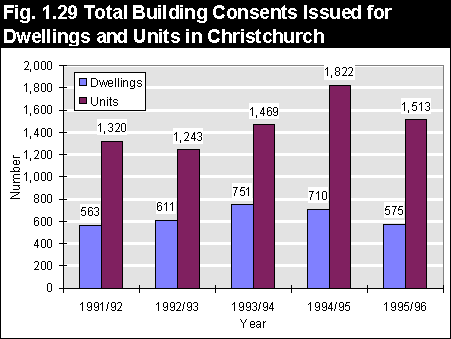
Between 1991 and 1996 a total of 7,367 building consents were issued for units within the City. This translates to 70 percent of all residential construction. During the same period 3,210 building consents were issued for separate dwellings.
As Figure 1.29 shows, the number of consents issued for units increased significantly until the year to June 1995 when numbers reached 1,822. The unprecedented number of consents issued during 1994/95 could be partially attributable to public uncertainty prior to the notification of the Proposed City Plan[35]. This uncertainty may have resulted in some developers and home builders obtaining building consents in advance of any possible City Plan rule changes.
In 1996, unit consents numbers fell by 300, although the actual number of consents was similar to that of the 1993/94 year. This suggests that growth in units within the City may be returning to the pre 1994/95 levels.
Source: Christchurch City Council