
This page is not a current Christchurch City Council document. Please read our disclaimer.

The infant mortality rate[30] is recognised as being a sensitive indicator of social and economic conditions and is often used to make international comparisons, especially in less developed countries.
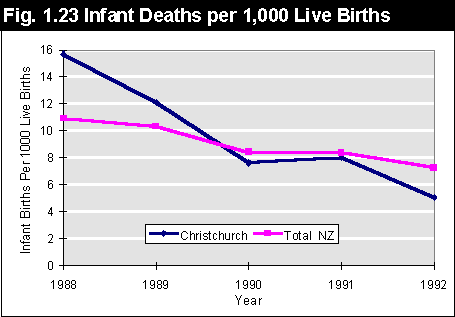
Infant mortality in New Zealand has steadily declined over the last three decades, from a rate of 22.6 per 1,000 total births in 1960, to 16.7 in 1970, 13.0 in 1980 and 7.3 in 1992. The infant mortality rate in Christchurch has declined even more rapidly than the national figure. In 1988, there were 15.7 infant deaths per 1,000 live births in the City. By 1992, the rate had fallen substantially to 5.1 deaths per 1,000 live births (Figure 1.23).
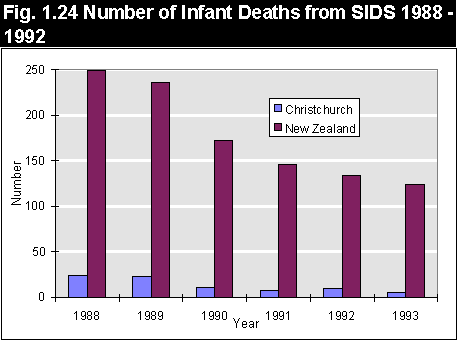
The primary cause of infant mortality in Christchurch between 1988 and 1992 was sudden infant death syndrome (SIDS) also known as ‘cot death’(Table 1.10). Despite being the major cause of infant death, the number of deaths due to SIDS declined significantly during this period both in Christchurch and at a national level (Figure 1.24). This decline coincided with a major educational campaign on known factors associated with SIDS.
Source: Ministry of Health Information Service, Mortality Data
| Table 1.10 Infant Death by Major Cause, 1988 -1992 | |||||
Christchurch |
% |
New Zealand |
% |
||
| Congenital anomalies | 44 |
21.4 |
664 |
24.9 |
|
| Perinatal causes | 71 |
34.5 |
750 |
28.1 |
|
| SIDS | 74 |
35.9 |
937 |
35.1 |
|
| All other | 17 |
8.3 |
320 |
12 |
|
| Total | 206 |
100 |
2,671 |
100 |
|
Source: Ministry of Health Information Service, Mortality Data
Source: Ministry of Health Information Service, Mortality Data