
This page is not a current Christchurch City Council document. Please read our disclaimer.

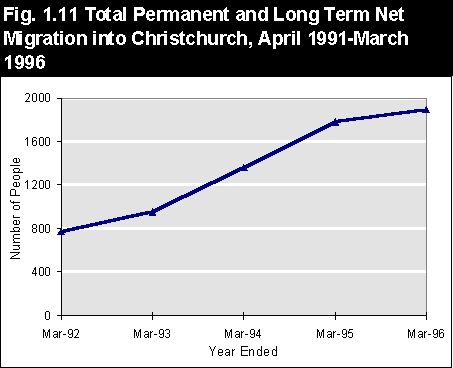
The net inflow of overseas residents into Christchurch more than doubled between April 1991 and March 1996. In the year to March 1992, the net gain for the City was only 770 people. By March 1996, this inflow had risen to 1,895 people per year (Figure 1.11). Although the rate of growth has slowed during the past year net migration still remains high. Over the last five years 25,586 people arrived in Christchurch on a long term or permanent basis while 18,822 people departed for an overseas destination. The net result for Christchurch was a gain of 6,764 residents. These figures include departing and returning New Zealand citizens.
Families with young children, and young adults make up the two largest groups arriving in the City in recent years. Between April 1991 and March 1996, 38 percent of arrivals to the City were aged 25-39 years and 19 percent were children aged 0-14 years indicating a high proportion of families. More than one quarter of arrivals were aged 15-24 years, reflecting the growing number of overseas students attending Christchurch’s secondary schools and tertiary institutions.
Source: Statistics New Zealand, External Migration Data
Although there have been a large number of arrivals aged 15-24 years, there has actually been an overall net migration loss of 329 people in this age group. This is attributable to the large number of young New Zealanders departing for overseas destinations, particularly the British Isles and Australia (33 and 31 percent of total departures in the 15-24 age group respectively).
The City is also losing slightly more elderly people to overseas destinations than is being gained. Since April 1991, there has been a net migration loss of 94 people aged over 60 years. Migration statistics show that the 60 percent of people in this age group departing the country on a long term basis intended to settle in Australia.
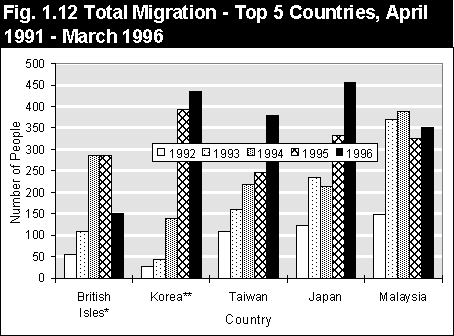
The largest source of net gain from migration over the past five years has been from Malaysia. During this period, 1,874 people arrived, and 290 people departed for Malaysia. The net migration gain from Malaysia was 1,584 people. Japan, the British Isles, Taiwan and Korea have also been major sources of new immigrants.
Figure 1.12 illustrates the trend in migration for the five countries with the highest rates of net inflow. Of particular interest is the large increase in the number of migrants from Korea. In 1994, there were 139 migrants from Korea but this figure has more than trebled to 434 people in 1996. Migration from the British Isles declined sharply during the past year, this is due to an increase in people departing for the British Isles.
It is also interesting, if not particularly surprising, to note the high level of movement between Christchurch and Australia. The net result of this activity has been an overall loss of 1,480 people over the last five years (Table 1.5).
Source: Statistics New Zealand, External Migration Data
| Table 1.5 Migrant Arrivals and Departures By Country of Origin or Destination, 1991-1996 | |||
Country |
Arrivals |
Departures |
Net Migration |
| Australia | 5,745 |
7,225 |
-1,480 |
| British Isles* | 5,479 |
4,592 |
887 |
| Canada | 395 |
336 |
59 |
| China | 377 |
86 |
291 |
| Hong Kong | 492 |
151 |
341 |
| Indonesia | 177 |
112 |
65 |
| Japan | 2,462 |
1,103 |
1,359 |
| Korea** | 1,110 |
72 |
1,038 |
| Malaysia | 1,874 |
290 |
1,584 |
| Netherlands | 289 |
195 |
94 |
| Pacific Islands*** | 503 |
406 |
97 |
| Singapore | 373 |
174 |
199 |
| South Africa | 345 |
90 |
255 |
| Taiwan | 1,163 |
54 |
1,109 |
| Thailand | 263 |
124 |
139 |
| USA | 1,197 |
1,133 |
64 |
| Other Countries | 3,342 |
2,679 |
663 |
| Total | 25,586 |
18,822 |
6,764 |
*British Isles Includes England, Ireland, Scotland and Wales
**Korea includes the Republic of and People's Democratic Republic of
***Pacific Islands Include Cook Islands, Tonga, Fiji and Samoa
Source: Statistics New Zealand, External Migration Data