
This page is not a current Christchurch City Council document. Please read our disclaimer.

At a national level, life expectancy at birth has increased substantially during this century. In 1991-93, life expectancy for a new born baby in New Zealand was 76 years. This compares with 69 years in 1950-52. Although the country’s population is living longer as a whole, substantial variations remain in the life expectancies of men and women. In 1991-93, the life expectancy for males at birth was 73.1 years while females could be expected to live nearly six years longer (78.9 years of age). This gap has actually widened over time. In 1950-52 men were expected to live for 67.2 years and women for 71.3 years, a difference of 4.1 years compared to the current margin of 5.8 years.
Christchurch residents are also living longer than ever before. In 1987-91, life expectancy at birth for people living in the City was 75.4 years. This increased from 74.7 years in the period 1982-1986. The variation in the life expectancies between males and females is not available for Christchurch during this period however, life expectancy in the Canterbury region in 1990-92 was 73.2 years for males and 79.4 for females.
Over the next twenty years the life expectancy of people born in Christchurch is expected to steadily improve. According to latest population projections, a male born in 2016 can expect to live about 77 years of age while a female could live to around 82 years.
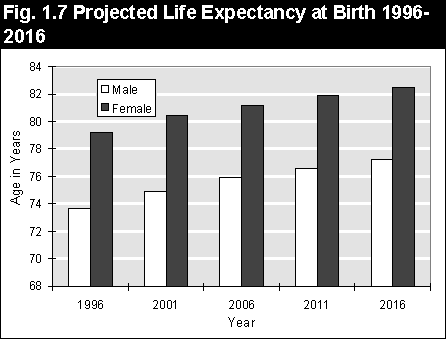
Source: Statistics New Zealand, Population Projections (January 1996)
The general improvement in life expectancy, particularly in recent years, has been achieved through lower mortality at late-working and retirement ages and a reduction in mortality in younger age groups, especially from sudden infant death syndrome (or cot death). Increases in life expectancy and the movement of the large baby boom generation into retirement ages mean there will be more elderly people living in Christchurch in the future. In addition, age differentials between spouses mean there will be more women spending greater proportions of their later years on their own.
| Table 1.3 Historical and Projected Population by Age (Medium Assumption) | |||||||
| Year | 0-14 years |
% |
15-64 years |
% |
65 years+ |
% |
Total |
| Historical | |||||||
| 1981 | 63,531 |
23.1 |
179,889 |
65.3 |
32,070 |
11.6 |
275,490 |
| 1986 | 58,020 |
20.6 |
187,950 |
66.8 |
35,313 |
12.6 |
281,283 |
| 1991 | 56,448 |
19.5 |
193,662 |
67.0 |
38,793 |
13.4 |
288,903 |
| Projected | |||||||
| 1996 | 62,150 |
19.9 |
207,420 |
66.5 |
42,320 |
13.6 |
311,890 |
| 2001 | 65,700 |
20.0 |
219,270 |
66.6 |
44,100 |
13.4 |
329,070 |
| 2006 | 64,170 |
18.9 |
228,450 |
67.4 |
46,240 |
13.6 |
338,860 |
| 2011 | 61,060 |
17.6 |
235,920 |
67.9 |
50,230 |
14.5 |
347,210 |
| 2016 | 58,680 |
16.5 |
238,100 |
67.1 |
57,900 |
16.3 |
354,680 |